

Blog
Simplicity is the ultimate form of sophistication. This principle perfectly reflects the philosophy behind SIRAFLEX spring balancers—the tools that SIRA S.p.A. develops and offers to make industrial work less strenuous, more precise, and safer. When a balancer works really well, the operator forgets it’s even there: the tool is always there, exactly where it’s needed, without any effort.
What is a spring balancer? How does it work? What types are available in the SIRAFLEX lineup? And, most importantly, how do you choose the right one for your specific application? From manual assembly stations to automated production lines, and from light loads of just a few ettos up to 120 kg: the right balancer is out there, and at SIRA S.p.A., we’ll help you find it.
What is a spring balancer, and how does it work?
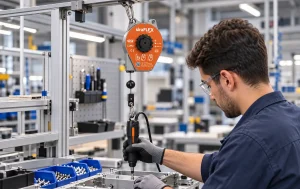
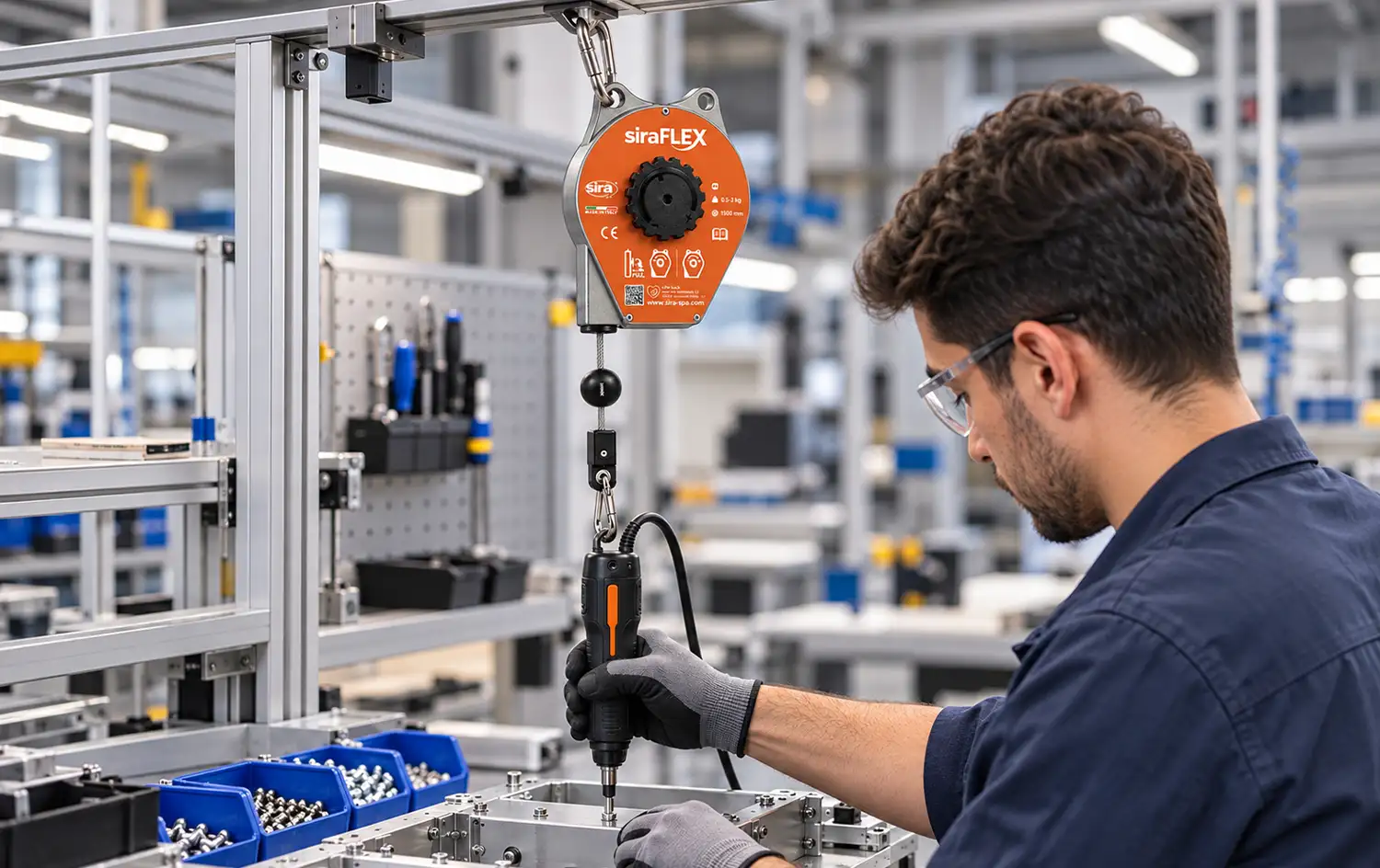
A spring balancer, also known as a balancer or spring-loaded balancer, is a mechanical device that counterbalances the weight of a tool or suspended object, making it feel virtually weightless in the operator’s hand. The operating principle is based on an internal coil spring, sized to exert an upward vertical force equal and opposite to the weight of the load: when the operator releases the tool, the balancer winds it back to its starting position; when the operator pulls it downward, the spring extends, gradually releasing the cable without any perceptible resistance.
The result is that the operator feels as though their tool—whether it’s a 3-kg pneumatic screwdriver, a 5-kg impact wrench, or a 20-kg specialty tool—weighs nothing. This isn’t just a matter of comfort—it’s a matter of process quality and operator health.
| SIRAFLEX, a brand of SIRA S.p.A. SIRAFLEX is the registered trademark of SIRA S.p.A. for its line of spring balancers. Developed in-house and manufactured to the company’s own specifications, it is one of the few products sold under the company’s own brand, alongside Siratec, confirming the engineering expertise gained over more than 50 years of specialized activity in industrial assembly. The SIRAFLEX line is available for loads ranging from 0.5 to 120 kg, in various configurations and housing designs to meet every application need. |
Why Spring Balancers Are Essential to Process Quality
1. Ergonomics and the Prevention of Work-Related Illnesses
In the technical literature on occupational health, tools held in the air without support for consecutive hours are among the leading causes of musculoskeletal disorders (MSDs): tendinitis, carpal tunnel syndrome, and shoulder and neck pain. The systematic use of spring-loaded balancers significantly reduces the static load on the joints, as documented in the INAIL guidelines for the prevention of musculoskeletal disorders caused by repetitive work. A fatigued worker is a worker who makes mistakes: the balancer is therefore not only a tool for well-being but also a tool for quality.
2. Clamping Precision
An unsupported screwdriver tends to wobble and tilt during tightening, especially on vertical joints or in awkward positions. The balancer keeps the tool in a stable vertical position, ensuring that the tightening axis is aligned with the screw axis. This detail, which is often overlooked, directly affects the quality of the tightening and the repeatability of the process.
3. Tool Protection
Without a balancer, the tool is placed on surfaces, dropped, or held in awkward positions during work breaks. With the balancer, the tool is always suspended in the correct position, protected from impacts and falls. Given the high cost of electronic torque-controlled screwdrivers, which can run into the thousands of euros, the protection provided by the balancer is an investment that pays for itself quickly.
What are the main features of SIRAFLEX spring balancers?
The SIRAFLEX line from SIRA S.p.A. covers a very wide load range, from 0.5 kg to 120 kg, and is available in various mechanical configurations and housing designs. Choosing the right configuration depends on three main factors: the weight of the load to be suspended, the required vertical stroke, and the physical characteristics of the workstation.
| SIRAFLEX Line | Load range | Typical Application | Construction Notes |
| Lightweight | 0.5–3 kg | Electric screwdrivers, lightweight impact wrenches, measuring tools | Compact, ideal for tight spaces |
| Media | 3–10 kg | Pneumatic screwdrivers, grinders, standard tools | The most widely used range in assembly |
| Heavy | 10–30 kg | Impact wrenches, high-torque guns | Reinforced structure, high-load spring |
| Very heavy | 30–80 kg | Specialty Tools, Welding Machines, and Spot Welders | For large-scale industrial facilities |
| Extra Heavy | 80–120 kg | Large-scale equipment, manipulators | Dedicated industrial facility |
How to Choose the Right SIRAFLEX Balancer for Your Needs
Step 1 – Measure the exact weight of the load
Not the tool’s rated weight, but its actual weight in operating configuration: tool + bit/socket + any air hose or tube. Air hoses and tubes add weight, and if they are secured to the side of the workstation, they significantly affect the balance.
Step 2 – Determine the required vertical travel
The stroke is the vertical distance the operator travels with the tool during the work cycle, from the rest position (tool suspended) to the clamping position (tool brought to the joint). SIRAFLEX models have strokes ranging from 800 mm to over 2,000 mm, depending on the size. An insufficient stroke forces the operator to jerk the tool; an excessive stroke leaves excess cable that gets in the way.
Step 3 – Assess the anchor point
The balancer is anchored to a fixed point above the workstation: a ceiling-mounted balancer, an articulated arm, a sliding rail, or a dedicated structure. The position of the anchor point relative to the tool’s point of use determines the working angle of the cable. SIRA S.p.A. also designs and supplies reaction and positioning arms, available in the “Assembly” section of the website catalog, which allow for the optimization of the suspension geometry even in complex workstations.
Step 4 – Consider the body configuration
SIRAFLEX is available in different housing options to suit various operating environments: a standard painted steel housing for normal environments, a galvanized steel housing for humid environments, and special configurations for environments with specific hygiene requirements. For applications in areas with specific risks, our technical team is available to evaluate the most suitable solution.
Step 5 – Check the Installation and Adjustment
Every SIRAFLEX balancer is equipped with a spring tension adjustment mechanism that allows you to fine-tune the balance after installation. The adjustment is correct when the tool remains stationary in the position in which the operator leaves it, without moving up or down on its own. The team SIRA Service can assist with installation and initial adjustment, and offers periodic maintenance contracts to ensure long-term performance.
What are the typical applications of SIRAFLEX balancers?
| Industry | Typical suspended tool | Recommended SIRAFLEX Range |
| Automotive Assembly | Uryu Impact Wrenches, Pneumatic Wrenches | Medium / Heavy (3–30 kg) |
| Industrial Electronics | Kilews and Delvo Microtorque Electric Screwdrivers | Lightweight (0.5–3 kg) |
| Home Appliance Manufacturing | Air Martin Direct-Drive Pneumatic Screwdrivers | Medium (3–10 kg) |
| MRO: Heavy Maintenance | Impact wrenches, angle grinders | Heavy / Very heavy (10–80 kg) |
| Machining | Trapani, reamers, special tools | Medium / Heavy (5–30 kg) |
| Multi-tool workstations | Set of tools used alternately by the same operator | Mid-range model with sliding rail |
How to Perform Maintenance on a SIRAFLEX Balancer
Spring balancers are mechanically simple devices, but their long-term reliability depends on proper periodic maintenance. The main maintenance tasks include:
- Visual inspection of the rope: check for broken strands, twists, or abnormal wear at the sliding point
- Check the end hook: Make sure the tool’s coupling mechanism is intact and shows no signs of deformation
- Cleaning the rewind mechanism: Remove any shavings or dust that could interfere with the smooth running of the cable
- Checking the Adjustment: Periodically check to make sure the balance is still correct, especially after replacing the tool
The SIRA Service program includes periodic maintenance of SIRAFLEX balancers, including tension checks, cable replacement as needed, and functional testing. For information on maintenance contracts, visit the page dedicated to SIRA Service.
Applications and Industries for Spring Balancers
Spring balancers are used in a wide range of industries, including manufacturing, construction, and the automotive sector, and contribute significantly to the efficiency of industrial processes.
- In manufacturing, these devices make it easier to lift and move heavy tools, reducing the risk of fatigue for operators and improving the precision of assembly operations.
- In the construction industry, balancers are used to support tools and equipment, making work at heights safer.
- In the automotive industry, they are used to optimize assembly lines, ensuring a smooth workflow and consistent quality of the final product. Finally, in industry in general, spring balancers offer customized solutions for various applications, proving essential for improving ergonomics and overall productivity.
Regulations and Certifications for Spring Balancers
Spring balancers, such as those in the SIRAFLEX line, must comply with specific regulations and certifications to ensure operator safety and food-grade compatibility in certain applications.
Current regulations establish strict requirements regarding the materials used, the design, and the manufacture of the devices, ensuring that they are free of harmful substances and suitable for use in the workplace.
Certified balancers provide safety guarantees, reducing the risk of workplace accidents through thorough testing that verifies the product’s strength and reliability. It is essential that companies take these certifications into account when selecting spring balancers, in order to ensure not only optimal performance but also a safe work environment that complies with current regulations.
What is the difference between a spring balancer and an articulated arm?
At some workstations, the choice isn’t just between different balancer models, but between a spring-loaded balancer and an ergonomic articulated arm. Here are the main differences:
| Feature | Spring balancer | Ergonomic articulated arm |
| Investment Cost | Low-Medium | Medium-High |
| Workstation Dimensions | Minimum (rope only) | Significant (physical arm) |
| Freedom of Movement | Elevated (360°) | Limited to the arm’s range of motion |
| Positioning Accuracy | Good | Excellent (lockable position) |
| Suitable for loads >30 kg | Yes (heavy ranges) | Yes (heavy arms) |
| Installation | Simple: a fixed point | Requires a dedicated facility |
The choice between the two solutions depends on the specific context. For workstations where the operator moves freely around the workpiece, the spring-loaded balancer is almost always the best choice due to its minimal footprint. For fixed workstations where the clamping point is always the same, the articulated arm can offer greater precision. At SIRA S.p.A., we design both solutions through our Siratec division.
CONTACT US NOWFAQ – Frequently Asked Questions About Spring Balancers
How do I choose the right SIRAFLEX balancer for my needs?
To choose the right SIRAFLEX balancer, it is essential to consider the exact weight of the load, the required vertical travel, and the anchor point. Make sure the balancer you choose effectively supports the tool being used.
Tips for Buying a Spring Balancer
Carefully evaluate the balancer’s technical specifications in relation to its intended use. Check its design features and make sure replacement parts will be available over time. It is helpful to consult an expert to ensure you make the right choice.
What is a spring balancer used for?
A spring-loaded balancer is used to keep tools suspended, reducing operator fatigue during prolonged use. It also improves the precision of assembly operations and protects tools from accidental damage.