

Blog
Automating the screwdriving process is one of the most significant steps a manufacturing company can take on its journey toward smart manufacturing.
Eliminating or reducing manual intervention in the clamping process increases process repeatability, reduces scrap, speeds up production, and frees operators from repetitive and potentially strenuous tasks.
What is an automatic screwdriving system?
An automatic fastening system is an integrated set of mechanical, pneumatic, and electronic components that automates the entire fastening sequence. This includes feeding the screw to the tool, positioning it on the joint, applying torque, verifying the tightening, and moving on to the next joint—all with little or no manual intervention.
Depending on the level of automation required, these systems can be:
- Semi-automatic: The operator positions the workpiece and starts the cycle; the system automatically feeds the screw and tightens it
- Integrated automatic systems: the system is integrated into an automated production line, with fully autonomous workpiece transfer and clamping cycles
- Robotic: An anthropomorphic or Cartesian robot moves the clamping tool to programmed positions, performing complex cycles on variable geometries
What are the main components of an automatic screwdriving system?
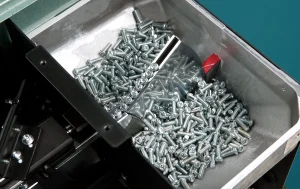
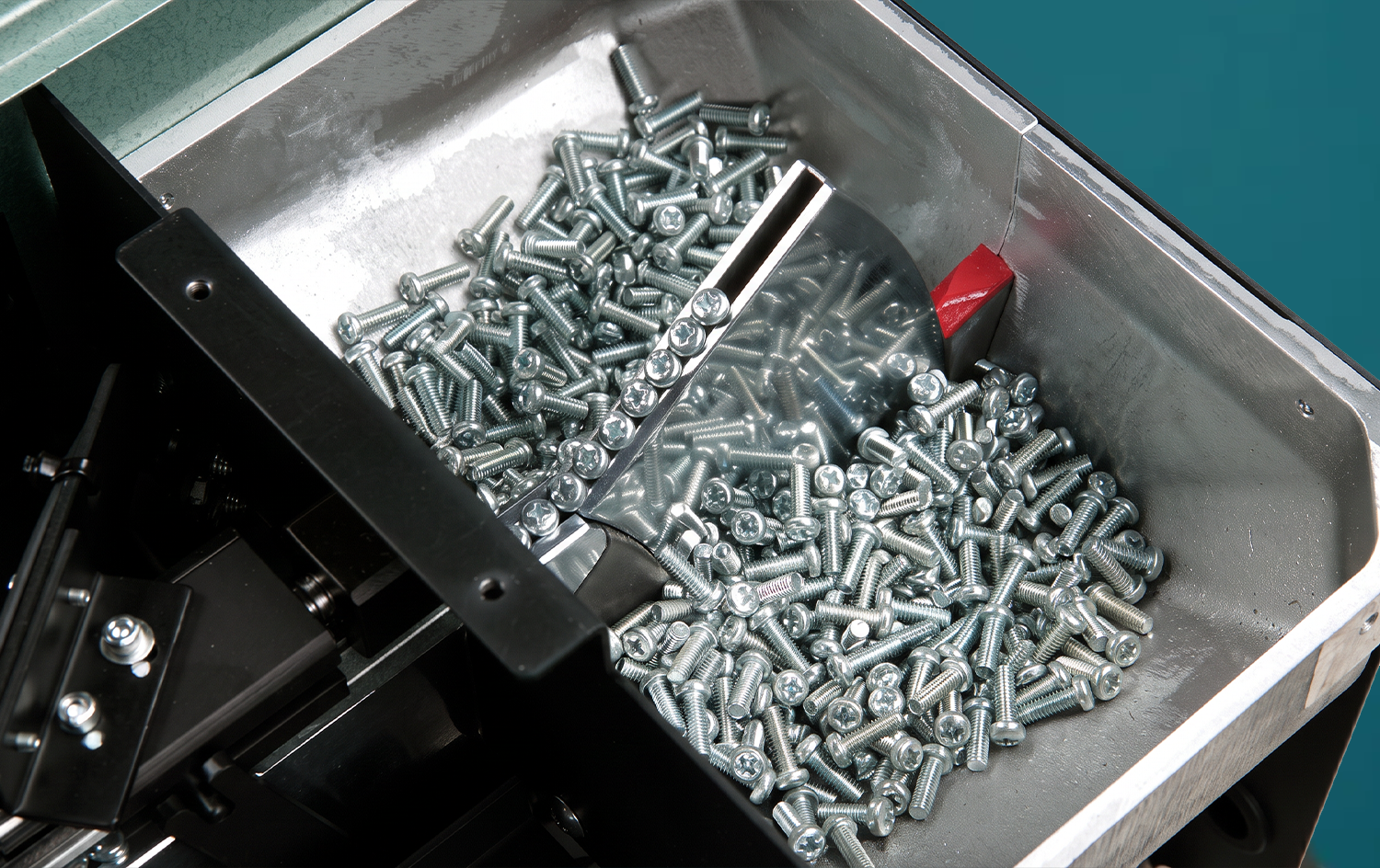
1. Screw feeder (vibrating bowl or tilting blade)
The logistical heart of the system. The screws are loaded into a hopper (vibrating bowl or conveyor belt), which aligns them and feeds them one at a time tothe feeder’s outlet. From there, they are conveyed via a flexible hose to the fastening point. Nittoseiko, the leading Japanese manufacturer whose products we distribute, has been a global specialist in this technology for over 80 years.
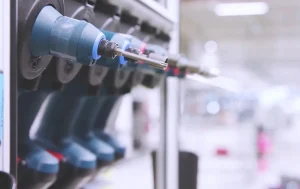
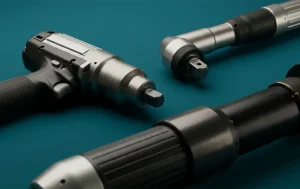
2. Screwdriving Unit
The tool itself: a screwdriver with built-in torque control, mounted on a fixed or movable mechanical stand. It can be equipped with a suction system to hold the screw in place before tightening, which is essential for applications involving small screws or in difficult positions.
3. Process Controller
The electronic unit that manages the entire operational sequence: it receives the start command, coordinates the power supply, controls the tightening cycle (target torque, angle, speed), verifies the result, and signals any anomalies. In the most advanced systems, the controller integrates with the factory’s MES for complete traceability.
4. Mechanical Structure and Guide
The frame on which the power supply and screwdrivers are mounted, along with any linear guides for automatic positioning across multiple joints. It can be fixed (dedicated workstation) or mobile (on a cart or integrated into an automated line). Siratec, our engineering division, designs these custom structures in compliance with machine safety regulations.
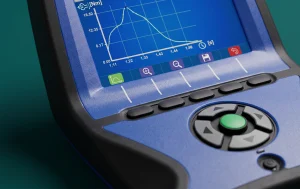
5. Human-Machine Interface (HMI)
Control panel displaying clamping parameters, process status, alarms, and statistics. In Industry 4.0 systems, the HMI is integrated with MES/SCADA supervisory systems for real-time production monitoring.
| Siratec – Engineering for Assembly Automation Siratec is the division of SIRA S.p.A. dedicated to the design and manufacture of custom automated assembly systems, including automatic screwdriving systems. Every Siratec project is developed with a focus on ergonomics, machine safety (Directive 2006/42/EC and subsequent Directive 2023/1230), and energy efficiency. The result is always a solution tailored to the customer’s actual needs, not a modified off-the-shelf product. |
Practical Tips for Choosing an Automatic Screwdriving System
When choosing an automatic fastening system, consider the following factors:
- Joint Type: Evaluate the type of joint to be assembled and its compatibility with the fastening system.
- Production volume: Determine the daily production volume to choose between semi-automatic or fully automatic systems.
- Available space: Consider the spaceavailable on the production line for installing the system.
- Traceability: Verify whether traceability of fasteners is required and select a system that supports this feature.
- Support and maintenance: Inquire about the availability of post-installation support and maintenance to ensure continuous operation.
Integration of Automatic Screwdriving Systems with Industrial Robots
The integration of automatic screwdriving systems with industrial robots represents a key step toward optimizing production processes. This synergy makes it possible to combine screwdriving technology with robotic applications, improving efficiency and precision in assembly operations. Screwdriving spindles, mounted on robotic arms, can perform complex cycles on variable geometries, ensuring uniform and traceable tightening.
The communication interfaces between the process controller and the robots enable integrated operations management, facilitating real-time monitoring and adaptation to varying production needs. In this context, assembly systems gain the flexibility needed to meet the challenges of modern industry, thereby increasing companies’ competitiveness.
How the Automatic Tightening Cycle Works
The operating cycle of an automatic fastening system follows a precise sequence that is repeated for each joint:
- Screw loading: The screw is picked up from the feeder, fed to the tool, and held in place at the tool holder
- Positioning: The tool moves into position over the joint, guided by a fixed mechanical system or a programmable axis
- Tightening start: the cycle starts automatically (or upon operator command in semi-automatic systems); the screwdriver rotates, driving the screw into place
- Torque/angle control: the controller monitors the applied torque in real time and, if required, the angle of rotation; it stops the cycle when the target is reached
- Verification and Indication: The system verifies that the values fall within the permitted parameters; it displays “OK” (green) or “NOK” (red) and, in the event of an anomaly, can stop the workpiece from advancing
- Data logging: Each clamping operation is logged with torque, angle, timestamp, and part ID, which is essential for traceability
Advantages and Features of Automatic Screwdriving Systems
Automatic screwdriving systems offer numerous advantages and features that make them essential for industrial assembly. Their high reliability ensures continuous, trouble-free operation, minimizing downtime.
Tightening precision is another crucial aspect, as each screw is tightened to an exact torque, thereby contributing to the quality of the final product. Furthermore, these systems are designed to reduce human error through an automated process that minimizes the likelihood of inaccuracies caused by manual intervention.
Flexibility is another key feature; the systems can be easily adapted to different production lines and types of fasteners. Finally, the growing focus on sustainability has led to the development of recyclable solutions, reducing the environmental impact of the materials used in automated fastening processes.
When Is It Best to Automate the Screw-Tightening Process?
| Condition | Is automation cost-effective? | Notes |
| High production volume (>500 units/day) | Yes | Fast ROI, high repeatability |
| Critical joints requiring traceability | Yes | Automotive OEMs, aerospace |
| Small screws (<m4 o=”” difficili=”” da=”” maneggiare=””></m4> | Yes | Reduces errors and operator time |
| Repetitive, physically demanding tasks | Yes | Ergonomic benefits and safety |
| Low volume, high joint variability | No/To be evaluated | Manual flexibility is often superior |
| Prototyping or custom manufacturing | No | Manual tools are more suitable |
How Siratec Works: The Implementation Process
Building an automated fastening system isn’t just about buying a product—it’s about developing a solution. The process we follow with each customer through Siratec is divided into specific phases:
- Process Analysis: We collect all relevant parameters, including joints, torques, volumes, available space, and the required level of traceability
- Conceptual Design: We define the system architecture, the type of feeder, the most suitable spindle, and the workstation layout
- Detailed design: We develop the mechanical drawings, controller programming, and complete technical documentation
- Manufacturing and Testing: We build the system in our workshop and test it through a full production cycle before delivery
- Installation and Commissioning: The SIRA Service team installs the system at the customer’s site, trains the staff, and verifies the production process
- Post-installation support: preventive maintenance contracts, remote assistance, and availability of genuine replacement parts
For a preliminary, no-obligation assessment of your process, please contact our team.
CONTACT US NOWFAQ – Frequently Asked Questions About the Automatic Screwdriving System
What are the basic principles of an automatic screwdriving system?
An automatic screwdriving system operates through an integrated set of mechanical, pneumatic, and electronic components that automate the tightening sequence, improving efficiency and reducing manual intervention.
How is an automatic screwdriving system integrated into a production line?
Integration involves positioning the system within the production line, allowing the tightening cycle to operate autonomously and coordinate with the other machines on the line.
How is an automatic screwdriving system maintained?
Maintenance includes periodic inspections of mechanical and electronic components, cleaning the feed unit, and verifying that the tool and the process controller are functioning properly.
How are the screws fed into the system?
Screws can be fed via a vibrating hopper feeder or via pick-and-place systems that pick up the screws and position them on the tool.
How much does an automatic screwdriving system cost?
The cost varies depending on the system’s complexity and the customer’s specific requirements; we recommend requesting a customized quote for detailed information.