

Blog
In modern industrial assembly lines, the quality of the tightening process cannot be left to the operator’s judgment or the variability of an uncontrolled tool.
To ensure the safety of the final product, regulatory compliance, and the traceability required by the customer, the tightening tool must not only guarantee that the target torque is achieved, but also that it does so in a measurable, documentable, and repeatable manner. Controlled electric screwdrivers are the industrial solution to this need.
What Is a Controlled Electric Screwdriver?
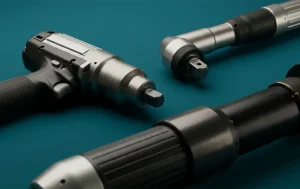
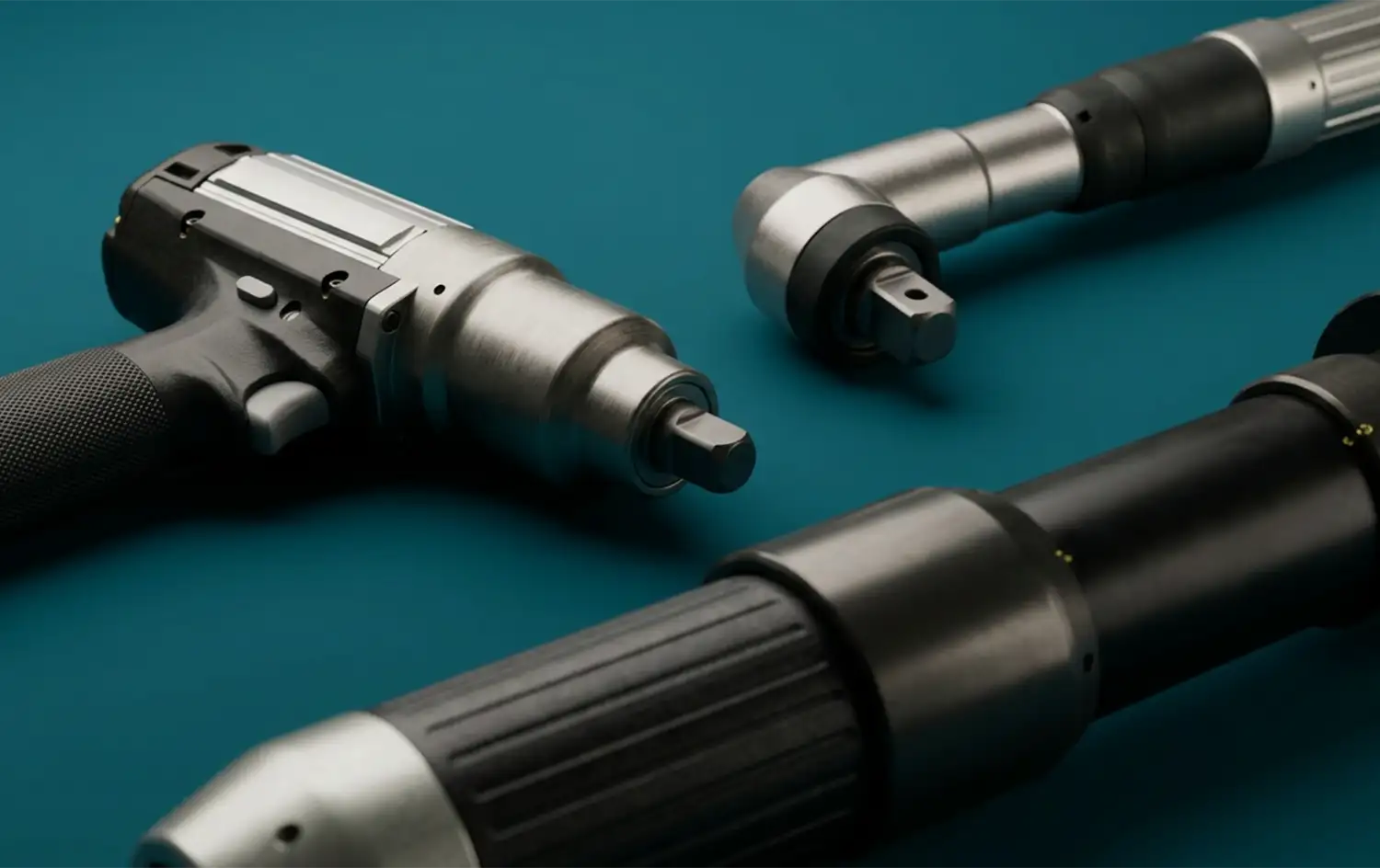
Controlled electric screwdrivers are tightening tools equipped with a system for controlling and measuring the applied torque. Unlike a traditional screwdriver (pneumatic or uncontrolledelectric ), it does not merely transmit rotational force; it measures the torque being applied in real time, compares it to the programmed target value, and stops the cycle when that value is reached.
In the most advanced models, the control also extends to the angle of rotation—a parameter that, when combined with torque, allows for a much more reliable verification of the actual preload in the joint. In models with integrated data collection, every tightening operation is recorded and can be stored, analyzed, and transmitted to the factory’s quality control systems.
| The difference between torque-controlled and non-torque- ed screwdrivers A non-torque- ed screwdriver (standard pneumatic, electric with a simple mechanical clutch) achieves an approximate torque that depends on air pressure, wear on the mechanism, the operator’s technique, and temperature. The actual variation can be ±20% or more. A torque-controlled electric screwdriver achieves the target torque with a typical variation of ±5%, which is measurable and certifiable. |
How Torque Control Works
Torque control in an electric screwdriver is achieved through two main technologies, each with different characteristics and levels of precision.
Current Absorption Control
The simplest and least expensive method is one in which the system detects torque indirectly by measuring the motor’s current draw. When the motor encounters increasing resistance (as the clutch engages), it draws more current: the controller detects this increase and interrupts the cycle. Typical accuracy: ±10%. Suitable for medium-criticality applications where instrument cost is a significant factor, such as the Kilews SGT-CC series that we distribute.
Strain Gauge Control
In the most precise method, a torque transducer is integrated directly into the tool. It measures torque with high precision in real time. This is the principle used in the transducer-equipped screwdrivers of the KL-GTCS and KL-TCG series from Kilews, as well as in the Panasonic and Kuken systems that we distribute. Typical accuracy: ±5%
Torque + Angle Control
The most advanced development: the system simultaneously measures torque and angle of rotation. The combination of these two parameters makes it possible to detect anomalies—such as defective screws, damaged threads, and non-compliant material—that a torque-only check would miss, and to verify the actual preload in the joint with greater reliability. Mandatory in automotive OEM and aerospace processes. Available in Estic ENRZ and Nittoseiko systems.
When a controlled electric screwdriver is the only option
The right question isn’t “Do I want a controlled screwdriver?” but “Does my process require a controlled screwdriver?” In many contexts, the answer is yes—not out of preference, but because of regulatory, contractual, or quality requirements.
Technical criteria for selection
Once it has been determined that the process requires a controlled electric screwdriver, selecting the correct model is based on six key parameters.
1. Target Pair and Trading Range
The most obvious but most critical parameter. The screwdriver must operate within 20–80% of its rated range to ensure the specified accuracy. A 0–5 Nm screwdriver used to tighten at 0.3 Nm (6% of full scale) will have an actual accuracy much lower than its rated accuracy. The Kilews range available from SIRA S.p.A. covers 0.1 Nm (SGT-CS301) up to 25 Nm (SKT-CG250), with specific product families for each range.
2. Required Level of Accuracy and Traceability
Three practical levels: ±5–10% (current absorption, medium criticality), ±3–5% (transducer, high criticality). In automotive OEM and aerospace processes, traceability of every fastening operation is mandatory; therefore, a system with data collection and archiving is required—not just a torque-controlled screwdriver.
3. Torque check, torque + angle, or torque + angle + thread
Torque-only testing is sufficient for most certified industrial applications. Torque-plus-angle testing is required for critical joints where preload must be verified with a high degree of reliability. Torque+angle+thread inspection adds verification of thread integrity, detecting defective screws or poorly threaded holes before the cycle is complete, thereby preventing downstream scrap.
4. Geometric shape: straight, angular, and pistol-shaped
The screwdriver type must be suited to the geometry of the joint’s access point. A standard straight screwdriver is suitable for most locations. An angled screwdriver is required when the joint’s axis is perpendicular to the access axis.
5. Connectivity and Industry 4.0 Integration
Modern controlled electric screwdrivers are not standalone tools: they are nodes in a quality network. The available connectivity options— USB, RS-232, Ethernet, Bluetooth, Wi-Fi, Modbus, and OPC-UA—determine how easily tightening data is transmitted to the MES, the quality management system, or the corporate cloud. For the most advanced production lines, the Estic systems we distribute through the Siratec division offer full integration into Industry 4.0 architectures with data collection for each spindle.
6. ESD Protection
When assembling electronic components that are sensitive to electrostatic discharge, a screwdriver with built-in ESD protection is required. The Kilews SGT-CS and SGT-LCS models with the “ESD” suffix are specifically designed for these environments.
Relevant regulations for controlled electric screwdrivers
Using controlled electric screwdrivers in certified processes requires knowledge of the relevant regulatory framework. The main applicable standards are:
- ISO 5393: Test Methods for Rotary Screwdrivers, the standard for the qualification of industrial screwdrivers.
- IATF 16949: Automotive Quality Management System, requires traceability of critical components, tool qualification, and MSA (Measurement System Analysis) management.
- EN 9100 / AS9100: Aerospace quality management systems, with even more stringent requirements for traceability and instrument qualification.
- ISO 9001:2015: The basic requirement for the calibration and management of measuring instruments in production processes includes torque-controlled screwdrivers.
Brands of controlled electric screwdrivers distributed by SIRA S.p.A.
SIRA S.p.A. distributes a complete line of controlled electric screwdrivers, covering every level of need—from professional to the most demanding.
Kilews
The Kilews Lineup Kilews available from SIRA S.p.A. covers three technology families: KL-GTCS (torque + angle + thread, 10″ touchscreen), KL-TCG (German transducer, 99 programs, Ethernet), and KL-TCC (current consumption, medium criticality). Torque ranges from 0.1 to 25 Nm in straight, long, and angle configurations.
Panasonic
The systems Panasonic industrial assembly systems cover a wider torque range than Kilews, with solutions designed for mass production lines and direct integration with Panasonic controllers. Brushless technology, torque-and-angle control, and connectivity for quality assurance systems. The choice for those seeking top-tier Japanese reliability in automotive and precision applications.
Bosch Exact
The line Bosch Exact is the benchmark for Tier 1 and OEM automotive assembly. Torque-controlled screwdrivers, multi-step programming, full connectivity, and a structured ecosystem of high-quality controllers and software. SIRA S.p.A. distributes the Exact line as part of its screwdriver portfolio.
Estic
The Engines Estic motors are the solution for those integrating screwdriving into automated systems: torques ranging from 0.5 to 300 Nm, interfaces for robotics and vision systems, and communication with PLCs and MES. Through the Siratec division of SIRA S.p.A., we design and manufacture complete automatic screwdriving systems with integrated Estic motors.
CONTACT US NOWFAQ – Frequently Asked Questions About Controlled Electric Screwdrivers
How much does a controlled screwdriver cost?
Prices vary dramatically. It all depends on the difference between a mechanical clutch model for hobbyists or craftsmen and a “smart” industrial system with a control unit, transducer, and data tracking for assembly lines.
What is the difference between an electric screwdriver and an electronically controlled screwdriver?
A standard electric screwdriver transmits rotational force without measuring the applied torque; at most, it has an adjustable mechanical clutch. An electronically controlled screwdriver measures torque in real time using a transducer or by monitoring current draw; it stops the cycle when the target is reached and can record the data. The difference lies between a tightening tool and a measurement and control tool.
How often should a controlled electric screwdriver be calibrated?
The frequency depends on the intensity of use and the criticality of the process. Annually or every N cycles, whichever comes first. For automotive OEM or aerospace processes, the frequency may be higher.