

Blog
In the world of industrial assembly, torque is one of the most critical parameters and, at the same time, one of the most frequently overlooked in non-certified processes. The integrity of every joint depends on it: too much torque can deform or break the screw; too little leaves the joint loose, with the risk of serious consequences.
Whether you are a production manager, a process engineer, or part of a technical department, you will find a brief operational overview here.
What is torque control in industrial assembly?
Torque control in industrial assembly is the process by which the rotational force—expressed in newton-meters—applied to screws, bolts, and nuts during tightening is measured and adjusted. The goal is to ensure that each joint is tightened to the correct torque: enough to withstand operational stresses, but not so much as to damage the threads or the mated components.
The reason this process is so important in industrial settings is simple: insufficient torque exposes the joint to the risk of gradual loosening, especially in the presence of continuous vibrations; excessive torque, on the other hand, can lead to fastener failure or deformation of the parts. In industries where margins for error are tight—such as the automotive, aerospace, and electronics sectors—this balance cannot be left to the operator’s judgment but must be measured, verified, and documented.
Recording and validating torque data for each production cycle means being able to demonstrate, at any time, that every joint has been tightened according to specifications—a requirement that is becoming increasingly critical in the most demanding supply chains.
What Is Tightening Torque?
Tightening torque, or simply torque, is the rotational force applied to a screw or bolt during tightening, expressed in Newton-meters (Nm). When tightening a joint, this torque is converted into an axial force—the preload—that holds the parts together. It is this preload, not the torque itself, that ensures the joint’s long-term strength.
The relationship between the applied torque and the resulting preload is not direct: it depends on the friction in the threads, the friction under the screw head, the lubricant used, and the geometric characteristics of the joint. This is why ISO 16047, which defines the procedures for torque testing of threaded fasteners, is the fundamental technical reference for anyone working on critical joints.
| Key Definition Torque control: a set of technologies, tools, and procedures that enable a predetermined torque value to be applied to a joint with defined precision in a measurable, repeatable, and—in certified processes—traceable and documentable manner. |
Why is torque control important in manufacturing?
Because improper tightening comes at a cost. A defective component can cost hundreds of euros; a product recall can cost millions; and an accident caused by a faulty joint can have far worse consequences. But there are concrete operational reasons why torque control is a necessity, not an option.
1. Quality of the finished product
In an uncontrolled fastening process, the variability in tightening torque can be enormous. A tired operator applies less torque than a colleague from the previous shift. A bolt tightened in the summer behaves differently than one tightened in the winter. A worn pneumatic impact wrench delivers 15% less torque than specified. All these variables, when combined, result in a variation in preload that can compromise the integrity of the product.
2. Safety of Operators and End Users
In industries such as automotive and aerospace, insufficient tightening of a structural joint is not only a quality issue but also a safety issue. For this reason, assembly protocols require the mandatory use of tools with certified torque control, and each individual operation must be documented.
3. Regulatory Compliance and Certifications
Major automotive OEMs require their suppliers to comply with standards such as IATF 16949, which mandates statistical management of the fastening process, data traceability, and tool qualification. Similarly, in the aerospace industry, the AS9100 standards and the specific requirements of the major prime contractors apply.
4. Reduction in Operating Costs
Torque control isn’t just a cost—it’s an investment that pays for itself quickly. Fewer defects, fewer reworks, fewer returns, and fewer recalls. And fewer tool failures, because a properly calibrated screwdriver operates within its optimal parameters rather than being pushed beyond its limits.
How do you measure torque?
There are various torque control technologies available, each offering different levels of precision and integration. The choice depends on the criticality of the process, the production volume, and the required level of traceability.
Mechanical Torque Control
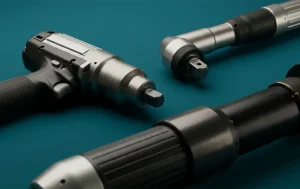
The simplest method: the screwdriver automatically disengages when it reaches the set torque. Tools such as the Delvo (Nitto Kohki) screwdrivers we distribute offer repeatability in the range of ±10%. They are suitable for semi-critical applications that do not require data logging.
Electronic Torque Control
A transducer measures the applied torque in real time; the control electronics either stop the process or signal when the target value has been reached. Typical repeatability: ±5%.
Torque + Angle Control
The combination of torque control and angle control is the “gold standard” for critical joints. Not only is torque measured, but angular rotation is as well: this combination makes it possible to detect anomalies (defective screws, debris in the threads, etc.) that torque control alone would not detect.
Torque wrenches with data logging
For manual operations or quality control, the electronic torque wrenches we distribute allow you to record every tightening operation performed, with the ability to export the data to quality control systems. Ideal for verification operations and end-of-line checks.
Data Management Systems: Complete Traceability
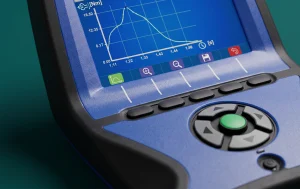
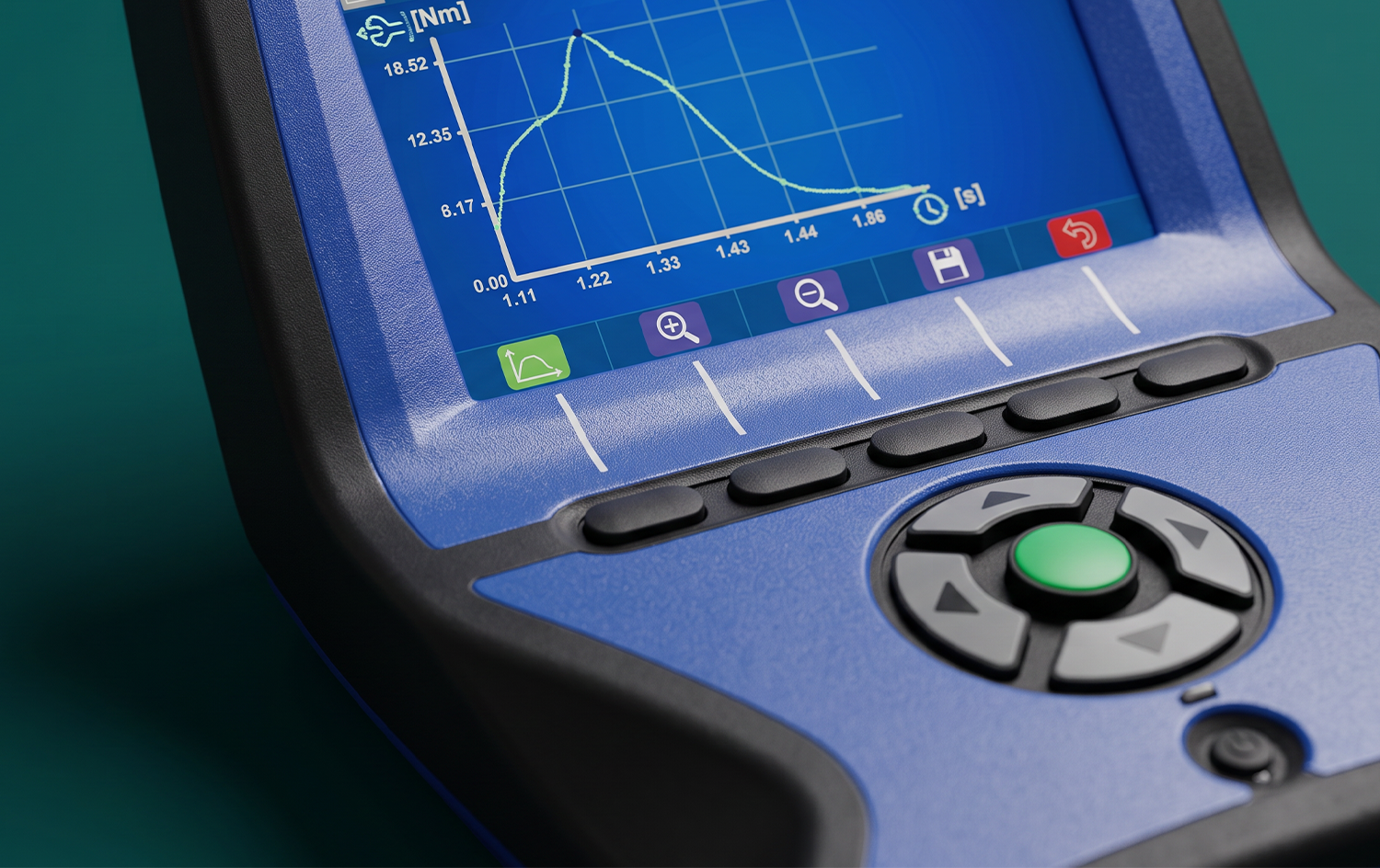
Torque control becomes truly powerful when combined with a system for collecting, storing, and analyzing tightening data. In this context, the CRANE and BMS systems —for which we are official distributors—represent a leading solution: they integrate torque control with OLED technology for on-machine display, wireless communication, and identification via scanners that read the codes on the workpiece.
This means that, for every part produced, it is possible to know the torque at which each joint was tightened, at which workstation, at what time, and with which tool. This data is essential for:
- Internal and external quality audits (ISO 9001, IATF, and AS9100 certification)
- Statistical Process Analysis (SPC – Statistical Process Control)
- Traceability in the Event of Returns or Recalls
- Predictive maintenance of tools (torque drift over time)
- Integration into factory MES/ERP systems (Industry 4.0)
Industry-Specific Applications of Torque Control
| Industry | Specific Requirements | Recommended Technology |
| Automotive OEM | Full traceability, torque + angle, IATF compliance | Electronic with data logging |
| Automotive Tier 1–2 | Certified torque control, SPC | Electronic with torque recording |
| Aerospace & Defense | AS9100, traceability for every joint, special procedures | Electronic torque+angle, wrenches with memo function |
| Industrial Electronics | Low torque/high precision, no component damage | Microtorque electronics, screwdrivers |
| Machines and systems | Structural couplings, medium-to-high torque | Hydraulic impact wrench + torque verification |
| MRO maintenance | Reliability, versatility, documentation | Controlled screwdriver + torque wrench |
How is a clamping process characterized?
The qualification of a tightening process—that is, demonstrating that the tool and procedure are capable of applying the target torque within the permitted tolerance—follows a structured process:
- Definition of target parameters: rated torque, tolerance, angle (if applicable), and coupling type.
- Tool selection: based on torque, required accuracy, and production context.
- Initial calibration: verification of the tool on a certified torque test bench.
- Process capability tests (Cp/Cpk), machine capability tests (Cm/Cmk): a series of test tightening cycles to measure the actual process variation.
- Maintenance plan: definition of the recalibration frequency and interim checks.
- Documentation: Archiving of qualification data and periodic updating of the plan.
We support our customers through every stage of this process, from the initial analysis of the joint to the development of a maintenance plan.
The SIRA S.p.A. program includes certified instrument calibration, repairs using original replacement parts, and ongoing technical support. Find out all the details at sira-spa.com/service.
Errors in Torque Control
Even those who use torque-controlled tools make mistakes that compromise process quality. Here are the most common ones we encounter in our technical support work:
- Missing or irregular calibration: An uncalibrated torque wrench may deliver torque that differs significantly from the rated value, rendering any checks ineffective.
- Friction not accounted for: Without standardized lubrication of the threads, the same applied torque generates different preloads.
- Incorrect parameter settings: An incorrect target value in the controller is a systematic error that results in all joints being equally incorrect.
- No maintenance plan: Torque wrenches wear out. The torque output changes over time if the tool is not inspected and maintained.
- Unanalyzed data: Collecting clamping data without analyzing it statistically is a missed opportunity. SPC is the tool that transforms data into useful information.
What are the risks of uncontrolled tightening?
Uncontrolled tightening can result in joints that are too loose or too tight, leading to malfunctions, component damage, and safety hazards.
Furthermore, it increases the likelihood of scrap, rework, and machine downtime, compromising product quality and the reliability of the production process.
Regulations and standards for industrial torque control?
Industrial torque control must comply with the regulations and standards applicable to the industry and the type of assembly. Key references include the ISO 6789 series, which covers manual torque wrenches, and ISO 5393, which addresses the performance of screw assembly tools.
The selection of testing tools and procedures must take into account the application’s technical specifications, quality requirements, and traceability needs.
FAQ – Frequently Asked Questions About Torque Control
What are the advantages of automatic torque control?
Automatic torque control ensures precise and repeatable tightening, reducing errors, scrap, and rework. It improves product quality and line productivity.
What are the benefits of Industry 4.0 in torque control?
Industry 4.0 enables the collection and analysis of tightening data in real time, improving traceability, quality control, and anomaly detection.
Training for operators on the use of torque-controlled tools?
Operators must understand how the tools work, how to set parameters, and the correct tightening procedures, as well as how to recognize any anomalies.
How can you prevent tightening errors using torque control?
It is important to set the torque correctly, use the proper tools, periodically check the calibration, and monitor the results to promptly identify any errors.
Guide to Choosing a Torque Transducer?
The choice depends on the measurement range, the required accuracy, the type of application, and compatibility with tools and data acquisition systems.